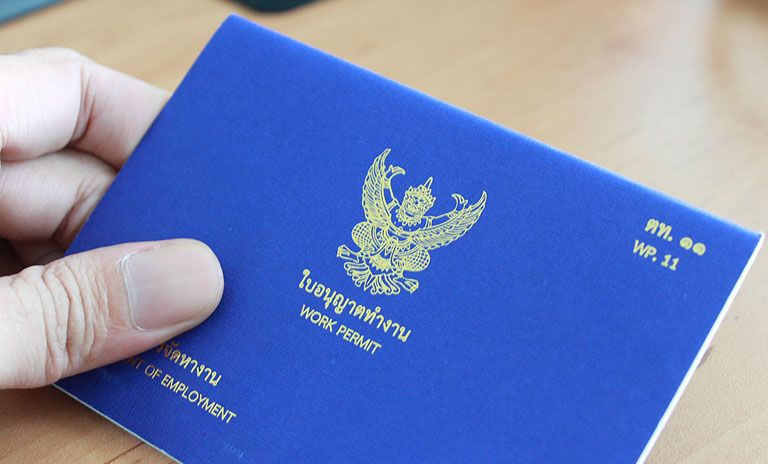
Foreign nationals who want to work in Thailand — as an employee, a skilled professional, or a director running their own business — need the correct visa and a work permit before they start work, not afterwards. Working without one exposes both the individual and the employer to penalties.
The visa is applied for at a Thai embassy or consulate outside Thailand.
The visa needed first is a non-immigrant visa, usually the Non-Immigrant B, obtained before entering Thailand. Once you are in Thailand on that visa, the work permit itself can be applied for. That step alone is usually processed in around seven working days once the file is complete; the whole sequence, from the company checks to the extension of stay, takes longer — see below.
The order things have to happen in
Almost every problem we are asked to fix here comes from doing the steps out of order. A work permit cannot be applied for on a tourist entry, and the company has to be in a position to sponsor before anything is filed for the individual.
- The company qualifies first. Paid-up capital and the Thai employee ratio are checked against the company, not the applicant.
- The employer obtains pre-approval so the applicant can collect the correct visa.
- The applicant obtains a non-immigrant B visa from a Thai embassy or consulate outside Thailand.
- The work permit is applied for once the applicant is in Thailand on that visa.
- The extension of stay is applied for at Immigration, so the permission to stay runs alongside the employment rather than expiring with the original visa.
Allow roughly four to eight weeks end to end for a standard case as a guide; the actual time depends on the provincial office and on how complete the documents are. BOI-promoted companies move considerably faster through the One Stop Service Centre.
What the company has to be able to show
- The capital the Department of Employment generally looks for is two million baht of paid-up capital for each foreign work permit holder. It must be paid up, not merely registered.
- The ratio generally applied is four Thai employees for each foreign employee, evidenced through social security filings — so the Thai staff have to be genuinely registered and contributing, not names on a list.
- Current tax and social security filings. Outstanding returns are one of the most common reasons an application stalls.
Both the capital test and the employee ratio are checked again at every annual renewal, not only at the first application. BOI-promoted companies are treated differently, and representative and regional offices work to their own ratio. These are assessment criteria applied by the Department of Employment rather than figures set out in legislation, and practice can differ between provincial offices.
Staying compliant once the permit is issued
- The 90-day report. Anyone staying in Thailand continuously for 90 days must report their address to Immigration. It can be filed in person, by post or online, and it is late more often than any other obligation we see.
- A re-entry permit before you travel. Leaving Thailand without one cancels the extension of stay, and the whole process has to begin again.
- The permit is tied to the employer and the role. Changing employer, job title or workplace means amending or re-applying — working outside what the permit states is an offence, even for the same company.
- Renewal before expiry. Start two to three months ahead. A lapsed permit cannot simply be renewed.
Visas that do not allow work
A retirement visa, a marriage visa or a visa exemption entry does not permit work. Holding a non-immigrant O visa through marriage can support a work permit application, but the permit itself is still required — the visa alone is not permission to work. Our expat visa guide for Thailand sets out the main categories and who each one suits.
What we do
- Check whether the company qualifies before anything is filed, and tell you plainly if it does not yet.
- Prepare the company-side documents and the employer pre-approval.
- Prepare and lodge the work permit application and the extension of stay.
- Handle annual renewals, 90-day reports and re-entry permits so they do not get missed.
- Where the company does not yet meet the capital or staffing tests, set out what has to change and in what order — which usually ties back to how the company was registered.
Fees and processing times at the Department of Employment and the Immigration Bureau change from time to time, and practice varies between provincial offices. We confirm the current position for Chonburi before quoting, rather than working from last year’s figures.
If you are not sure what you are doing it can be a heart breaking process full of unnecessary heartache so contact us we can arrange it all for you:
Contact Us